 how-to
Junk Removal for Church Cleanouts: Step-by-Step Guide
Table of Contents
- Why a Junk Removal for Church Cleanouts Plan Matters
- Your Church Cleanout Checklist: Step-by-Step
- Step 1: Get Leadership Sign-Off Before Anything Moves
- Step 2: Walk the Building and Build a Room-by-Room Inventory
- Step 3: Assign a Point Person Per Room
- Step 4: Pull Sacred, Archival, and Confidential Items First
- Step 5: Schedule Donation Pickups and the Hauling Crew
- Step 6: Prep the Building the Day Before
- Step 7: Run Cleanout Day in Waves
- Step 8: Final Walkthrough and Documentation
- Timelines by Scenario
- Handling Sacred, Archival, and Confidential Items
- Church Donation Pickup and Responsible Disposal
- Church Furniture Removal and Bulky Item Hauling
- Understanding Junk Removal Pricing for Churches
- Scheduling Your Church Cleanout Service
- Conclusion: Reclaim Your Church Space
- Frequently Asked Questions
Last Updated: October 15, 2026
Why a Junk Removal for Church Cleanouts Plan Matters
A church cleanout is the organized removal of unwanted items, furniture, and debris from a place of worship, and it succeeds or fails on planning, not muscle. Junk removal for church cleanouts works best when a team sorts items before the truck arrives, protects anything with historical or sentimental value, and routes usable goods to donation instead of a landfill.
The stakes are higher than a typical garage cleanout. Churches accumulate decades of donated furniture, decorations, hymnals, kitchen equipment, and records nobody wants to throw away by mistake, and a rushed cleanout can destroy something the congregation needed.
Below, we break down the full process, from the first walkthrough to the final sweep, plus how to handle sacred items, what drives cost, and how to schedule a crew.
Your Church Cleanout Checklist: Step-by-Step
A church cleanout checklist keeps the job moving in a logical order: sort first, haul second, clean third. Most congregations can complete a medium-sized cleanout in one to two days with a crew on site for the heavy lifting.
Step 1: Get Leadership Sign-Off Before Anything Moves
Before a single box is touched, confirm who has authority to approve removals, usually the pastor, the board or trustees, and the property committee chair. Put the scope in writing: which rooms are in scope, which items are protected, and who signs off on final disposal. A one-page memo prevents the mid-job argument that stalls crews.
Step 2: Walk the Building and Build a Room-by-Room Inventory
Walk every space and write down what's in each one. Include the spaces people forget: bell towers, boiler rooms, choir robe closets, kitchen pantries, attic crawl spaces, exterior storage sheds, and the back of the stage.
For each room, note:
- Approximate volume (a rough count of truckloads or a photo with a reference object for scale)
- Heavy or specialty items (pianos, organs, commercial kitchen equipment, safes)
- Anything that looks historic, sacred, or confidential
A phone photo of each room from the doorway becomes your before-and-after documentation and estimate reference.
Step 3: Assign a Point Person Per Room
Use four categories for everything you find:
- Keep: items the church uses regularly or that carry historical value
- Donate: usable furniture, working appliances, clean clothing, books in good condition
- Recycle: metal, cardboard, electronics where accepted locally
Assign a point person for each room so decisions don't stall. The most common mistake we see is a committee trying to vote on every item. Give one trusted person authority per space and move on. Mark donation items with colored tape before the crew arrives to prevent accidental hauling and speed up loading.
Step 4: Pull Sacred, Archival, and Confidential Items First
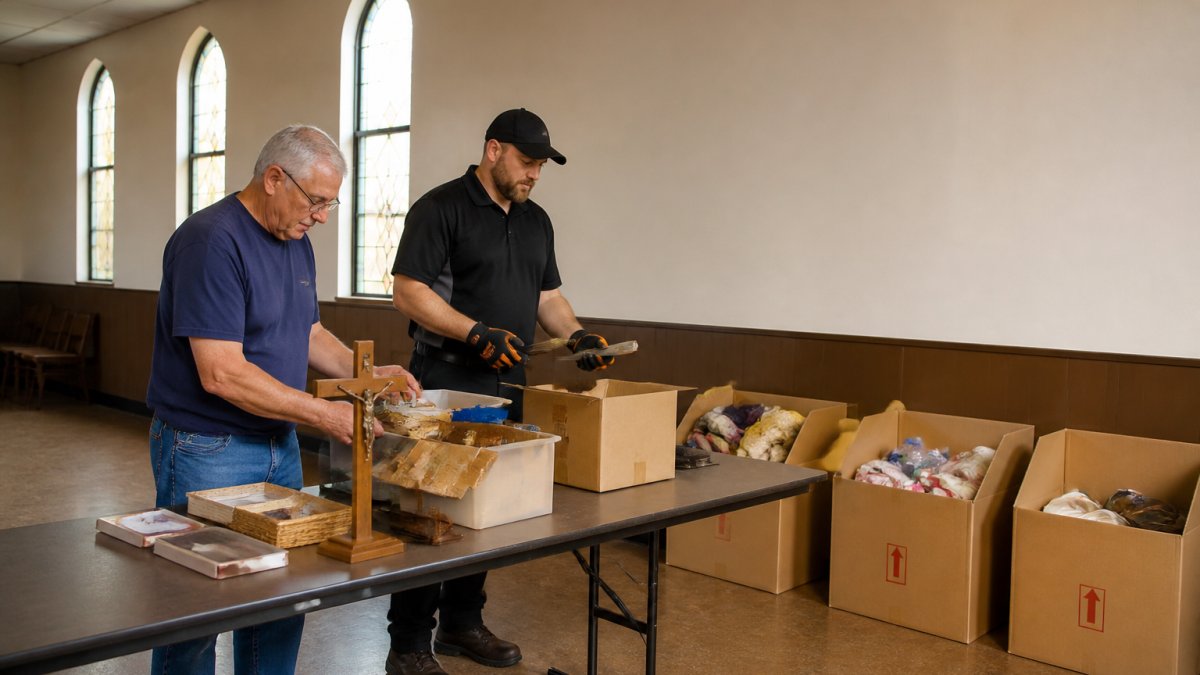
Before general sorting begins, remove anything requiring a leadership decision. Communion ware, baptismal and membership records, memorial plaques, historic photographs, founding documents, financial records, and pastoral counseling notes belong in a locked, labeled space that stays off-limits to the crew.
Step 5: Schedule Donation Pickups and the Hauling Crew
Call donation organizations two to three weeks before your cleanout date. Most have limited pickup windows, and the good ones book out fast. Book the hauling crew one to two weeks out for a standard cleanout, longer if you need donation pickups coordinated the same day. Confirm the crew size against your inventory so the right truck and labor show up.
Step 6: Prep the Building the Day Before
Small prep tasks save the most time on cleanout day:
- Clear a path from each room to the loading door
- Remove wall hangings and anything fragile near the carry route
- Lay down cardboard or moving blankets on hardwood, tile, and carpeted thresholds
Step 7: Run Cleanout Day in Waves
Work one zone at a time rather than letting volunteers scatter. Start with the largest-volume room (often the fellowship hall or storage area), then offices, then specialty spaces.
Set a staging area near the loading door for anything that needs a final decision, the best way to avoid the "wait, was that supposed to go?" moment halfway through the job.
Step 8: Final Walkthrough and Documentation
Walk every room after the crew leaves. Check closets, under-stage areas, and the back of storage rooms for anything missed, then photograph each room empty. File the before-and-after photos with the leadership memo and any donation receipts, boards, insurers, and auditors routinely ask for this documentation.
Timelines by Scenario
Different cleanouts need different pacing. A few common patterns:
- Storage room or single-space clearance: half a day with one crew and a few volunteers
- Fellowship hall and kitchen refresh: one day, with appliance disconnects scheduled the morning of
- Renovation prep: two to three days, sequenced room by room so construction isn't blocked
Handling Sacred, Archival, and Confidential Items
Sacred and archival items never go in the disposal pile without a decision from church leadership.
Set these items aside first, before any other sorting begins, in a locked room or labeled cabinet that stays off-limits to the crew.
Confidential material deserves the same care.
For items with historical value, contact your regional denominational office or a local historical society before discarding.
Church Donation Pickup and Responsible Disposal
Donation should be the default for anything usable, not the afterthought.
Call donation organizations two to three weeks before your cleanout date. Most have limited pickup windows, and the good ones book out fast.
Here's how we'd route the typical items:
| Item Type | Best Route | Why |
|---|---|---|
| Usable furniture | Donation pickup | Still functional, high demand |
| Working appliances | Donation or scrap recycler | Resale value or metal recovery |
| Clothing and linens | Donation | Accepted by most charities |
| Electronics | Certified e-waste recycler | Keeps hazardous components out of landfills |
| Broken furniture | Junk removal | No resale value, bulky |
| Expired chemicals and paint | Household hazardous waste facility | Requires special handling |
For the disposal side, ask your hauler where the material ends up. A reputable company recycles metal, separates e-waste, and can tell you which facility handles the rest, a fair question to ask before you book.
Church Furniture Removal and Bulky Item Hauling
Church furniture removal is the heaviest part of the job, and it's where professional crews earn their fee. Pews, pipe organs, pianos, commercial kitchen equipment, and solid oak tables are heavy, awkward, and often bolted down.
Bulky items that routinely need hauling from churches include:
- Pews and sanctuary seating
- Pianos, organs, and sound equipment
- Commercial refrigerators, stoves, and freezers
Measure doorways and stairwells before the crew arrives.
Some items need disassembly: pews often unbolt from floor rails, and commercial kitchen equipment disconnects at a shutoff valve.
Understanding Junk Removal Pricing for Churches
Junk removal pricing for churches depends on volume, weight, access, and labor, not a flat per-room rate. Most companies price by how much space your items take up in the truck, with adjustments for heavy materials like concrete, dirt, or appliances that carry disposal fees.
The Main Cost Drivers
- Volume: how much of the truck your items fill. Most trucks are sized in cubic yards, and a full truckload is the common unit of pricing.
- Weight: heavy debris costs more to dispose of than light bulk. Concrete, dirt, roofing material, and appliances carry per-ton or per-item disposal fees at the landfill or transfer station.
- Access: stairs, long carries, tight doorways, and no-elevator buildings add labor time. A basement cleanout with a narrow stairwell can take twice as long as the same volume at ground level.
How to Build a Rough Budget Before You Call
You don't need a quote to get in the ballpark. Use your room-by-room inventory and estimate truckloads:
- A single storage room or closet: usually well under a full truckload
- A fellowship hall with tables, chairs, and kitchen overflow: roughly one truckload
- A full building cleanout with pews, kitchen equipment, and office contents: multiple truckloads, often two to four
Multiply your estimated truckloads by the local per-load range from two or three quotes, then add a 10 to 20 percent contingency for the items nobody remembered. Boards approve budgets faster when the number is framed as a range with a stated contingency.
Nonprofit and Tax Considerations
Churches often qualify for nonprofit consideration, so ask directly whether the hauler offers a reduced rate for 501(c)(3) organizations, before you book, not after.
Donated property is the other lever. If your church donates usable goods to a qualified charitable organization, the donation may be tax-deductible, and the receiving organization can provide a receipt. Document what was donated with an itemized list and photos; for anything with meaningful value, a qualified appraisal may be needed.
Getting an Accurate Estimate
We recommend a free estimate with an on-site walkthrough rather than a phone guess, because photos rarely capture how much is really in a storage room. Have these ready:
- Your room-by-room inventory and photos
- A list of heavy or specialty items (pianos, organs, commercial equipment, safes)
- Access notes (stairs, narrow doors, parking limits)
Ask each hauler three questions before you sign: what happens to donated and recycled material, whether disposal fees are included or billed separately, and what happens if the job runs longer than estimated.
For current rates, request a free estimate from Rubbish Outlaw Junk Removal and we'll give you a no-obligation quote based on what's actually there.
Scheduling Your Church Cleanout Service
Scheduling a church cleanout service comes down to three things: a confirmed date, a clear scope, and a crew that can handle the volume.
When you call, have these ready:
- The number of rooms and rough item volume
- Any heavy or specialty items like pianos or commercial equipment
- Your preferred date and a backup date
Same-day and next-day service is often available for smaller jobs, but a full church cleanout usually needs a scheduled slot so the right crew size shows up.
Rubbish Outlaw Junk Removal serves churches, schools, and community organizations across Akron and Canton, Ohio, with fast scheduling and crews equipped for bulky furniture, debris removal, and full property cleanouts.
Conclusion: Reclaim Your Church Space
Clearing decades of accumulated items from a church is emotional work, and it's easy to let the logistics stall the project.
Rubbish Outlaw Junk Removal handles church cleanouts, furniture removal, debris hauling, and full property cleanouts for congregations across Akron and Canton, with fast scheduling, straightforward pricing, and responsible disposal.
Get started with Rubbish Outlaw Junk Removal and request your free estimate today.
Frequently Asked Questions
What items can a junk removal service take from a church?
Junk removal for church cleanouts typically covers furniture, appliances, old electronics, renovation debris, and general clutter. Most services also haul away bulky items like pews, pianos, and commercial kitchen equipment. However, hazardous materials such as paint, batteries, and chemicals often require special handling. Always ask the removal company what they accept before booking, and mention any sacred or confidential items so they can be handled respectfully.
How should a church sort donations, recycling, and items for disposal?
Start by setting up three zones: one for items in good condition to donate, one for recyclables like paper and metal, and one for trash. Use the church cleanout checklist to label each zone clearly. Have volunteers check donation guidelines for local charities, as some only accept certain items. This sorting step reduces landfill waste and can increase the amount you donate. A junk removal crew can then haul away the remaining disposal and recycling items in one trip.
How can a church schedule a cleanout without disrupting services or events?
Plan your church cleanout for a weekday or a day with no services or events. Contact the junk removal company at least a week in advance to book a time slot. Many services offer same-day or next-day availability, but scheduling ahead ensures you get the crew size you need. Clear the area of any items you want to keep, and mark parking or loading zones. If your church has multiple buildings, let the crew know so they can plan their route.
How much does junk removal for a church cleanout cost?
Junk removal pricing depends on the volume of items, their weight, and local disposal fees. For a church cleanout, costs can vary widely based on how full the space is and whether special handling is needed for heavy items like pianos or appliances. Most companies offer a free, no-obligation estimate after seeing photos or visiting the site. Request a quote from Rubbish Outlaw Junk Removal to get an accurate price for your specific cleanout.