 how-to
How to Recycle Bulky Furniture: A Step-by-Step Guide
Table of Contents
- Assess Your Furniture's Condition and Material
- How to Dispose of Old Furniture Through Donation
- Arrange Furniture Donation Pickup Services
- Schedule Bulky Item Pickup With Your Municipality
- How to Recycle a Mattress and Box Spring
- Repurpose or Upcycle Furniture Before Disposal
- Disassemble and Recycle Furniture Materials Separately
- Prepare and Handle Bulky Items Safely
- Frequently Asked Questions
Last Updated: October 7, 2026
Assess Your Furniture's Condition and Material
Before disposing of old furniture, determine whether it can be reused, donated, or if you need to recycle bulky furniture. Examine it for structural damage, stains, odors, or pests: a chair with a broken leg might be fixable; a mattress with visible mold is not.
Check for Damage, Contamination, or Pests
Press wooden frames for soft spots, look underneath for bed bugs or rodent droppings, and smell the piece, a musty odor can mean water damage or mold.
Contamination is a dealbreaker for donation. Most charities reject furniture with:
- Stains that won't come out
- Visible mold or mildew
- Strong odors (smoke, urine, decay)
If the piece fails any of these checks, donation is off the table, recycle or dispose of it instead.
Identify the Primary Material
Materials recycle differently, so knowing what you have helps you find the right facility. Common materials include:
- Wood: Solid wood, plywood, particle board, MDF
- Metal: Steel frames, aluminum legs, springs
- Fabric: Upholstery, cushions, foam padding
Mixed-material pieces, like a wooden frame with fabric upholstery, must be disassembled before recycling.
How to Dispose of Old Furniture Through Donation
If your furniture is in good condition, donation keeps it out of landfills and helps people in need.
Charities and reuse centers accept clean, functional beds, sofas, tables, and dressers. Call ahead, some are picky about condition.
Popular donation options include:
- Goodwill and Salvation Army: Accept most furniture types. Check their websites for local drop-off locations and what they accept.
- Local charities: Food banks, homeless shelters, and women's shelters often need furniture. Call ahead to confirm.
- Facebook Marketplace or Craigslist: List items for free or cheap. Buyers pick up, so you don't have to transport.
The key is finding an organization that accepts your specific item. A broken desk chair won't help anyone. A solid wood table in good shape will.
Arrange Furniture Donation Pickup Services
Many charities offer free pickup for bulky furniture, saving you a truck rental.
To schedule a pickup:
- Take clear photos of the furniture from multiple angles
- Call or visit the charity's website to request pickup
- Provide your address and describe the items
- Confirm the pickup date and time window
- Have the furniture ready and accessible on pickup day
Some charge a small pickup fee and others offer it free, ask when you call.
If no charity offers free pickup, a junk removal service loads and hauls the furniture for you. Pricing depends on quantity, dates, and distance.
Schedule Bulky Item Pickup With Your Municipality
Most cities and counties offer bulky-item pickup through trash service, often free or low-cost. It typically includes:
- Sofas and couches
- Mattresses and box springs
- Dressers and nightstands
Call your local waste management department or check its website, guidelines vary.
Verify Local Rules and Avoid Rejected Pickups
Before scheduling, confirm what your city accepts, rules vary widely.
Some cities accept all furniture. Others restrict what they take:
- No mattresses (due to bed bug concerns)
- No foam-filled items
- No items larger than a certain size
Check these details before putting furniture on the curb, rejected items get left behind.
Most municipalities require you to:
- Schedule pickup in advance (usually 1-2 weeks ahead)
- Place items at the curb by a certain time
- Keep items separate from regular trash
Get the exact schedule and rules from your local waste authority.
How to Recycle a Mattress and Box Spring
Mattresses and box springs are the hardest bulky furniture to dispose of responsibly: they're rarely accepted as regular trash, and many landfills ban them or charge a separate tipping fee. Yet a mattress is one of the most recyclable pieces you own, built from materials with established recycling streams.
What's Actually Inside a Mattress
A typical mattress and box spring break down into four recoverable material streams:
- Steel: Innersprings, box-spring coils, and edge support wire. This is the highest-value material and goes to scrap metal recyclers.
- Foam: Polyurethane and memory foam layers. Some facilities shred and re-bond this into carpet padding or cushion fill; others cannot process it and send it to landfill.
- Fiber and fabric: The quilted cover, batting, and any textile layers. Clean fiber can go to textile recovery; soiled or treated fabric usually cannot.
A mattress recycler runs the unit through a deconstruction line: steel is baled and sold, foam and fiber go to processors if a buyer exists, and the rest goes to disposal. Recovery rates vary, so don't assume "recycled" means 100% diverted.
Why Mattresses Are Regulated Separately
Many states and municipalities treat mattresses as a separate waste stream for two reasons: bulk and bed bugs. A mattress takes up far more landfill volume per pound than almost any household item, and a used one can carry bed bugs that spread quickly in collection trucks and transfer stations. You'll often see:
- Curbside bulky-item programs that explicitly exclude mattresses
- Landfills that accept mattresses only at a designated area, often for a per-unit fee
- Bans on mattresses in regular trash containers
How to Recycle a Mattress: Step by Step
- Confirm your local rules first. Call your municipal waste department or check their website. Ask: (a) Does the bulky-item program accept mattresses? (b) Is there a fee per unit? (c) Do I need to wrap or bag it?
- Check for a dedicated mattress recycler. Search for "mattress recycling" plus your city or county. Many states have at least one facility that accepts drop-offs from residents, sometimes free and sometimes for a per-unit fee.
- Ask about retailer take-back. If you're buying a replacement mattress, ask whether the retailer hauls away the old one. Many offer this as an add-on, and some states require retailers to offer recycling when they deliver a new mattress.
- Prepare the mattress for transport or pickup. Wrap it in plastic sheeting or a mattress bag to contain any pests and keep it dry. Tape the wrap closed. If you're dropping it off, secure it to your vehicle, a mattress catches wind like a sail.
- Separate the box spring if you can. Some recyclers accept mattresses and box springs together; others process them separately or charge per piece. Confirm before you load.
- Get a receipt or confirmation. If your municipality or recycler charges a fee, keep the receipt, some jurisdictions require proof of proper disposal for landlords or property managers.
Drop-Off vs. Pickup vs. Hauler
| Option | Typical cost pattern | Best for |
|---|---|---|
| Municipal bulky-item pickup | Free to low per-unit fee | Residents in cities with mattress-inclusive programs |
| Dedicated mattress recycler drop-off | Free to moderate per-unit fee | DIYers with a truck or trailer |
| Retailer take-back with new purchase | Add-on fee | Anyone buying a replacement |
| Junk removal / hauling service | Volume-based quote | Renters, no vehicle, tight timelines, multiple items |
Costs and availability vary by location, so treat the table as a pattern, not a price list, and confirm current fees before you schedule.
If transport is the blocker, no truck, no help, no time, a junk removal service will haul the mattress and route it to a recycler rather than a landfill. Ask the hauler directly where it's going before you book; not every hauler recycles.
Repurpose or Upcycle Furniture Before Disposal
Before you recycle or throw away furniture, consider repurposing it, upcycling extends its life, keeps it out of landfills, and saves money. Common projects include:
- Sand and refinish wooden furniture
- Reupholster chairs or sofas with new fabric
- Paint old dressers or cabinets
If you lack the skills or time to upcycle, donate the furniture, many DIYers will happily take it.
Disassemble and Recycle Furniture Materials Separately
Most furniture is a composite: a sofa is wood, metal, foam, fabric, and adhesive; a dresser is wood, particle board, metal hardware, and sometimes glass or stone. To recycle bulky furniture effectively, disassembly turns a bulky item into recyclable streams, and determines whether it gets recycled or landfilled in pieces.
Before You Pick Up a Tool
Two checks first:
- Is it worth disassembling? If the piece is solid wood, solid metal, or a single material, you may be able to deliver it whole to a recycler. Disassembly pays off when the piece is mixed-material and the components have separate destinations.
- Is it safe to disassemble? Older upholstered furniture may contain foam treated with flame retardants, and pre-1978 painted wood may contain lead paint. If you're sanding, cutting, or breaking apart either, wear a respirator and gloves and work outside or with ventilation. If unsure, don't cut it, haul it whole.
Tools That Make Disassembly Practical
- Cordless drill or screwdriver for removing hardware and brackets
- Utility knife for cutting upholstery fabric away from the frame
- Pry bar or hammer for separating stapled or nailed joints
Step-by-Step: Breaking Down a Typical Upholstered Sofa
- Remove cushions and pillows. These are usually the cleanest fabric items and the easiest to divert.
- Flip the sofa and remove the dust cover (the fabric stapled to the underside). This exposes the frame and hardware.
- Unbolt the legs and any modular sections. Metal legs and brackets go to scrap metal; wood legs go with the wood pile.
- Cut the upholstery away from the frame. Use a utility knife along the seams. Pull the fabric off in sheets.
- Separate the foam from the fabric. Foam and fabric go to different streams, don't bag them together.
- Remove the springs and any metal frame components. These are the highest-value recyclable in the piece.
- Break down the wood frame. Solid wood and untreated lumber can often be chipped or recovered; particle board and MDF usually cannot and typically go to disposal.
Where Each Material Actually Goes
Metal (highest recovery value)
- Accepted by: scrap metal recyclers, many municipal transfer stations
- Typical items: steel springs, aluminum legs, brass hardware, brackets, nails and screws in bulk
- Watch for: mixed metals bolted together, separate steel from aluminum where you can, since mixed loads pay less or get rejected
Solid wood and untreated lumber
- Accepted by: wood recyclers, lumber recovery programs, some composting facilities (untreated only)
- Typical items: solid wood frames, table tops, untreated pallets
- Watch for: painted, stained, or pressure-treated wood is usually excluded from wood recycling and often must go to disposal
Particle board, MDF, and plywood
- Accepted by: very few recyclers; most goes to disposal
- Why: the binders and adhesives in engineered wood contaminate wood-recycling streams
- Practical move: if the piece is mostly engineered wood, don't spend hours disassembling it, route it to bulky-item pickup or a hauler
Upholstery fabric and textiles
- Accepted by: textile recyclers, some donation centers that accept fabric scraps
- Typical items: clean, dry fabric cut from frames
- Watch for: stained, wet, or foam-backed fabric is usually rejected
Foam
- Accepted by: a limited number of foam recyclers; some carpet-padding manufacturers
- Reality check: foam recycling infrastructure is thin in most areas. If no local recycler accepts it, bag it and dispose of it with regular trash as a last resort, don't contaminate a fabric or wood load with it
Glass and stone
- Accepted by: glass recyclers (for glass tops), stone fabricators or landscape suppliers (for stone tops)
- Watch for: tempered glass and mirrored glass are often not accepted in curbside glass programs, confirm before you haul
Mattress and cushion foam
- See the mattress section above, these have their own dedicated stream
Verify Before You Haul
Recyclers change what they accept, and "recyclable" on a label doesn't mean your local facility takes it. Before loading up, call or check the facility's website for current accepted materials, size limits, minimum or per-load fees, and whether they accept mixed loads or require pre-sorted material.
When Disassembly Isn't Worth It
Disassembly takes time, tools, and a place to work. If any are missing, a bulky-item pickup or hauling service gets the same result with less effort. For a single sofa, DIY disassembly can be worth it; for a whole house cleanout, it usually isn't.
Prepare and Handle Bulky Items Safely
Moving bulky furniture safely protects your back, your home, and the items themselves, improper lifting causes injury, and poor handling damages doorways, floors, and stairs.
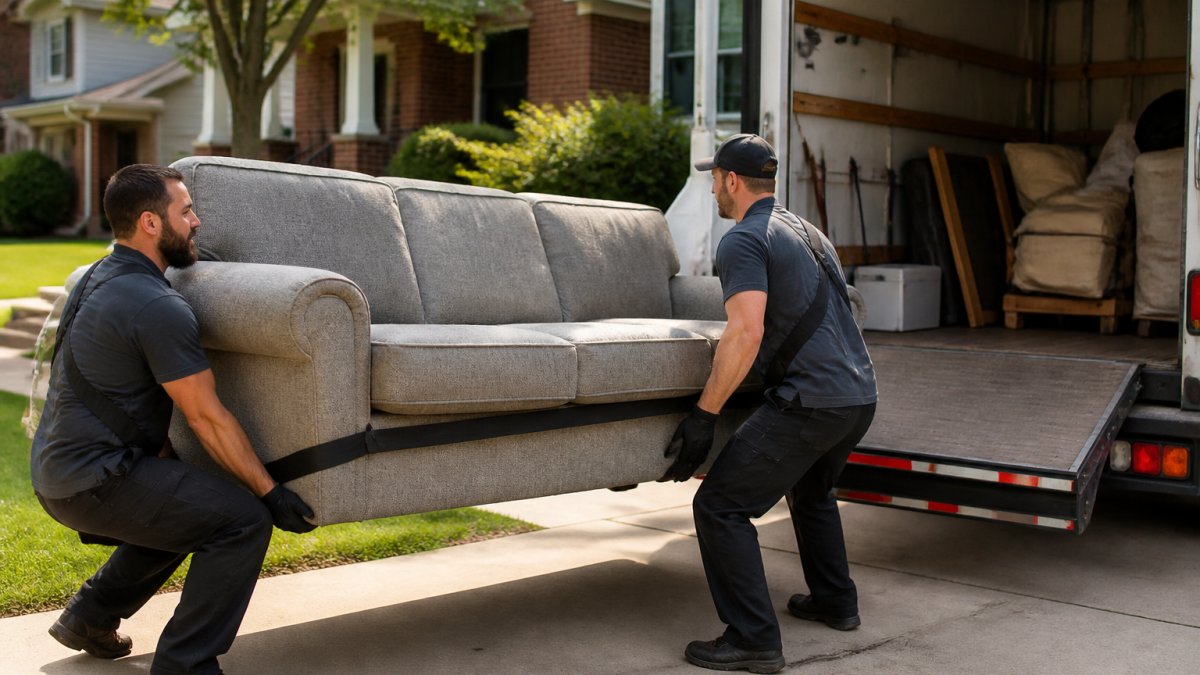
Before moving furniture:
- Clear the path: Remove obstacles, close doors, and measure doorways to confirm the piece fits
- Protect surfaces: Use blankets or cardboard to shield walls, floors, and the furniture itself
- Use proper lifting: Bend your knees, keep your back straight, and lift with your legs, not your back
- Get help: Never move large pieces alone. At least two people should handle sofas, dressers, and bed frames
- Use equipment: Furniture dollies, moving straps, and sliders reduce strain and prevent damage
- Disassemble if possible: Remove legs, arms, or shelves to make pieces smaller and lighter
For items too large or heavy to move safely, professional junk removal is the answer.
Getting rid of old furniture doesn't have to be complicated: assess what you have, choose the right disposal method, and handle items safely. Get a free estimate today and reclaim your space.
Frequently Asked Questions
Can bulky furniture be recycled if it is damaged?
Damaged furniture can sometimes be recycled, depending on the extent of damage and material type. Furniture with structural damage, water damage, or pest infestation is typically not suitable for donation but may still be recyclable through material-recovery facilities. Metal frames can often be separated and recycled even if upholstery is ruined. Check with local recycling facilities about their specific requirements for damaged items before disposal.
How do I prepare furniture for donation or recycling?
Clean the furniture thoroughly and inspect for damage, stains, or odors. Remove any personal items from drawers or compartments. If donating, ensure all parts are present and functional. For recycling, you may need to disassemble pieces to separate materials like metal, wood, and fabric. Document the item's condition with photos if arranging pickup. Contact your chosen donation organization or recycling facility for their specific preparation guidelines.
What are my options for bulky item pickup?
Most municipalities offer scheduled curbside bulky-item pickup or drop-off at designated collection sites. Many offer a bulk-item pass or annual permit allowing a set number of pickups. Donation organizations like Goodwill and Salvation Army offer free pickup for furniture in good condition. Private junk removal services handle items regardless of condition but typically charge a fee. Check your local waste management website for schedules, size restrictions, and any associated costs.
How do I recycle a mattress and box spring responsibly?
Mattresses and box springs are among the most difficult items to recycle because they contain multiple materials. Many municipalities have specialized mattress recycling programs or accept them at designated drop-off facilities. Some retailers offer mattress recycling when you purchase a replacement. Donation is possible only if the mattress is clean, free of stains, and in good condition. Contact your local solid waste management department or recycling facility to locate mattress-specific recycling options in your area.