 how-to
How Should You Prepare for a Cleanout?
Last Updated: October 25, 2026
Quick Summary
To prepare for cleanout, confirm what the term means for your situation, set a deadline and work backward from it, sort items before hauling, pull out documents, valuables and hazardous items, and clear a path for the crew. Most of the work happens before the truck arrives, so getting these steps right decides whether the job takes one day or three.
- Work room by room in this order: garage and shed, basement and attic, kitchen, bedrooms, living areas last.
- Book the hauling crew before you finish sorting so the arrival date matches your deadline.
- Donation pickups typically schedule one to three weeks out and require a confirmed appointment.
- Move all junk to one place, empty furniture, bag small items, and disconnect appliances before the crew arrives.
- Set hazardous items like paint, batteries and propane tanks in one labeled area and confirm your county's accepted list.
Table of Contents
- What "Cleanout" Means Before You Start Sorting
- Your House Cleanout Checklist, Room by Room
- Estate Cleanout Preparation: Documents, Heirlooms, and Family Decisions
- Building a Cleanout Timeline That Matches Your Deadline
- Junk Removal Preparation: What to Move, Empty, and Set Aside
- Hazardous Items and What Never Goes in the Truck
- Book Your Free Cleanout Estimate
- Frequently Asked Questions
What "Cleanout" Means Before You Start Sorting
The word "cleanout" means something different depending on who says it. For a homeowner in Akron facing a packed garage, it means hauling years of stuff out of a house.
This guide from Rubbish Outlaw Junk Removal focuses on how to prepare for cleanout of properties: houses, garages, basements, rentals, and estates. We clear out properties across Akron and Canton, so we know where people get stuck.
A property cleanout is the process of removing unwanted items, debris, and junk from a home or building so it can be sold, rented, repaired, or simply lived in again.
Here is the short version of what to do first:
- Confirm what "cleanout" means for your situation
- Set a deadline and work backward from it
- Sort before you haul
- Pull out documents, valuables, and hazardous items
- Clear a path for the crew
Get these five steps right and the rest is lifting. Skip them and you will be digging through boxes at the curb.
Your House Cleanout Checklist, Room by Room
A house cleanout checklist works best when you go room by room and finish one space before starting the next. Jumping between rooms is the most common mistake we see.
Work in this order:
- Garage and shed first. They hold the most bulk and the least sentiment.
- Basement and attic next. Check for water damage and pests as you go.
- Kitchen. Empty cabinets, then appliances.
- Bedrooms. Set aside personal items before touching furniture.
- Living areas last. Furniture goes out once the small stuff is gone.
For each room, use three piles: keep, donate, and haul. Add a fourth for anything you need to ask someone about. Label boxes as you fill them.
If you want help with the hauling itself, our house cleanout service covers full-property jobs.
Estate Cleanout Preparation: Documents, Heirlooms, and Family Decisions
Estate cleanout preparation starts with paper, not furniture. Before anything leaves the house, collect the documents that matter: wills, deeds, financial records, insurance papers, IDs, and photos.
Then handle the family side. Decisions about heirlooms go faster when everyone agrees on a process:
- Walk the house with a camera and photograph anything contested
- Give family members a set window to claim specific items
- Set one deadline for pickup, and stick to it
- Keep a written list of who took what
Grief makes this slow. That is normal. If sorting sentimental items is the hard part, this guide on how to sort sentimental items during cleanouts walks through it. When the family is ready to clear the property, our estate cleanout service handles the whole job.
Building a Cleanout Timeline That Matches Your Deadline
A timeline to prepare for cleanout should match your deadline, not your energy level.
Start by writing down the hard date, the closing date, the move-out date, the rental inspection, or the estate deadline. Then subtract the fixed lead times below.
| Constraint | Typical lead time | Why it matters |
|---|---|---|
| Junk removal crew booking | 2-7 days; longer at month-end | Crews fill up when leases turn over |
| Dumpster rental permit | 1-5 business days in many municipalities | Some jurisdictions require a right-of-way permit for street placement |
| Donation pickup scheduling | 1-3 weeks for most charities | Pickup slots are limited and fill early |
| Household hazardous waste event | Often monthly or quarterly | Drop-off dates are fixed; you cannot rush them |
| Utility shutoff and final meter read | 3-10 business days | Needed before a property is fully cleared |
With those lead times in hand, here is how the plan changes by deadline.
One week or less. Sort and haul in the same pass. Do not attempt to sell anything, the listing, showing, and pickup cycle alone eats three to five days.
Two to four weeks. Sort first, haul second. This is the window where donation pickups and a single dumpster rental both fit. Photograph and list high-value items in the first week, schedule donation pickup for the second, and book the final haul for the last three days. Keep a staging area, a garage bay or a taped-off corner of the driveway, so sorted piles do not get re-mixed.
Two months or more. Sort, donate, sell, then haul. The extra time is best spent on the sell step, not on more sorting. Online marketplaces move furniture and tools fastest in the first 72 hours of a listing, so batch your photos and post everything in one weekend.
Two dependencies trip people up more than any other. First, donation pickups: most charities schedule one to three weeks out and will not take items left at the curb without a confirmed appointment. Second, dumpster placement: if the driveway is blocked by a pile, the dumpster cannot be delivered, and the whole schedule slips. Clear the delivery spot before the container is scheduled to arrive.
If your deadline is tight and the property is large, the realistic trade-off is paying for labor you would otherwise do yourself.
Junk Removal Preparation: What to Move, Empty, and Set Aside
Junk removal preparation comes down to three actions: move items to an easy spot, empty what needs emptying, and set aside anything the crew should not take. Crews charge by volume, so every item you pre-sort saves you money.
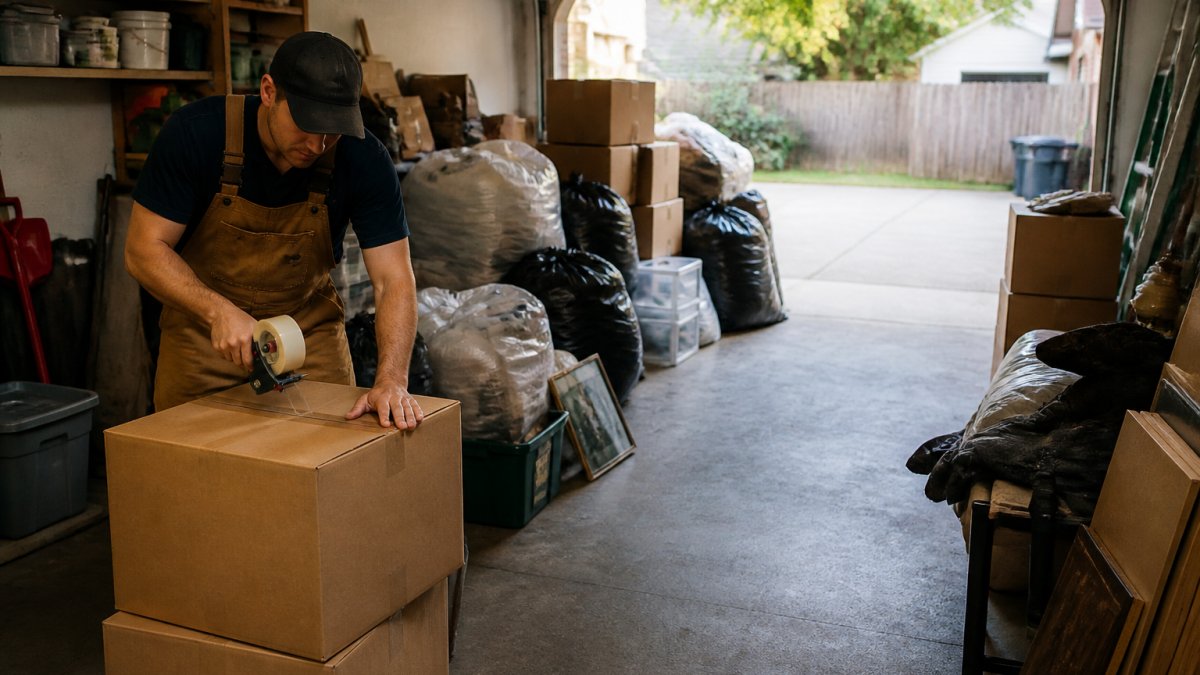
Do these before the truck shows up:
- Move it all to one place. Garage, driveway, or curb. Stairs slow every job down.
- Empty furniture. Dressers, cabinets, and desks should be cleared out.
- Bag the small stuff. Loose items take longer to load than bagged ones.
- Set aside keepers. Mark them clearly and put them in a room the crew will skip.
- Disconnect appliances. Unplug and unhook washers, dryers, and fridges.
A common mistake is leaving a path blocked. The crew needs a clear route from the pile to the truck. Ten minutes of clearing saves an hour of hauling.
Hazardous Items and What Never Goes in the Truck
Some items cannot go in a junk truck, and mixing them in with regular debris creates real problems. Old paint, batteries, motor oil, propane tanks, pesticides, and pool chemicals all need special handling.
Watch out: paint cans get tossed in with regular junk all the time, and a leaking can ruins an entire load. Keep them separate and take them to a local household hazardous waste drop-off.
Here is what to set aside, why it is restricted, and how to stage it safely:
- Paint, stain, and solvents. Liquids leak and ignite. Keep cans upright in a plastic tote with a lid, and do not consolidate different products into one container.
- Car batteries and lithium batteries. Lead-acid batteries leak acid; lithium batteries can thermal-runaway and ignite when punctured or crushed. Tape the terminals of loose lithium batteries and bag them individually.
- Propane tanks and aerosol cans. Pressurized containers can rupture in a compactor. Keep them upright and away from heat.
- Motor oil, antifreeze, and fuel. These are liquids that contaminate soil and water. Leave them in their original containers with lids tight.
- Pesticides and pool chemicals. Mixing incompatible chemicals can produce toxic gas. Never combine partial containers.
- Medical waste and needles. Sharps require a rigid sharps container; loose needles endanger handlers (the FDA). Use a commercial sharps container or a sealed, puncture-resistant container labeled clearly.
For paint specifically, this guide on safe disposal of old paint covers the step-by-step. Everything else goes to your county's hazardous waste collection event or drop-off site. Check your county's solid waste authority for dates and locations, and confirm what they accept before you load the car, many sites take paint and batteries but not propane tanks or ammunition.
A few items fall into a gray zone that trips people up. Ammunition and fireworks are not accepted at most household hazardous waste sites and usually require a police or fire department turn-in. Medications should go to a drug take-back program or a pharmacy kiosk rather than the trash.
Once the hazardous items are separated, the rest of the property can be cleared normally. Mark the hazardous staging area clearly so the crew knows to skip it, and keep it out of the path between the pile and the truck.
Book Your Free Cleanout Estimate
You have sorted, set aside, and cleared a path. Now the job needs a crew and a truck. Rubbish Outlaw Junk Removal handles full-property cleanouts, hoarder house cleanouts, demolition, debris removal, and even boat removal across Akron and Canton.
We work fast, keep pricing affordable, and take the whole job off your hands, from the first box to the last load. You do not need to know the exact cost before you call. Pricing depends on volume and access, and we quote it on site.
Get your free cleanout estimate and put a date on the calendar.
Frequently Asked Questions
How long should a property cleanout take?
A single garage or basement usually clears in a few hours with a full crew, while an entire estate property can take one to three days depending on volume and access. The cleanout timeline depends on how much has already been sorted, whether appliances and furniture need disassembly, and how many stairs or tight doorways the crew has to work around. Sorting and bagging before the crew arrives is the single biggest time saver.
What should you remove before a junk removal team arrives?
Pull out anything you are keeping, plus documents, cash, jewelry, medications, and keys. Set those items in a locked room or take them off site before the crew starts. Point out anything fragile or valuable you want handled separately, and clear a path to the door so hauling goes quickly. Everything left in the work area is treated as disposable, so label keep piles clearly.
What items should not go in a regular junk removal load?
Latex paint, motor oil, antifreeze, pool chemicals, propane tanks, batteries, and fluorescent bulbs are regulated as household hazardous waste and cannot ride in a standard junk load. In Ohio, many counties run collection days for these materials, so check your county's schedule before the cleanout. Appliances with refrigerant, like refrigerators and AC units, also need special handling in most cases.
How do you decide what to keep, donate, or throw away?
Use three questions: Have I used it in the past year? Would I buy it again today? Does someone else need it more? Anything usable and in good condition, such as furniture, tools, and clothing, goes to donation. Broken, stained, or incomplete items go to trash. For estate cleanout preparation, let family members claim keepsakes first, then set a firm deadline so sorting does not stall.
Clearing a property is heavy work, and the prep list above is only half of it. The other half is the loading, hauling, and disposal, and that is where a crew saves you days. Rubbish Outlaw Junk Removal brings fast service, affordable pricing, and full-service cleanouts, including hoarder house jobs that other companies turn down. Get started with Rubbish Outlaw Junk Removal and reclaim your space without doing the lifting yourself.