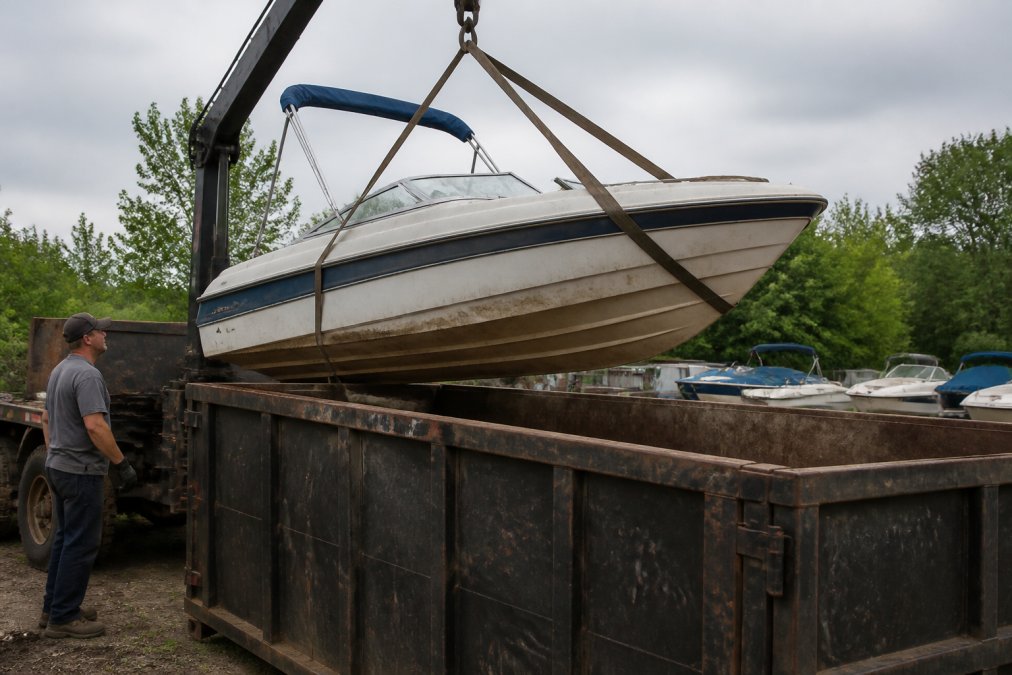
 how-to
Can Junk Removal Take Boats? A Complete Guide
Table of Contents
- Do Junk Removal Services Actually Take Boats?
- Types of Boats Junk Removal Services Accept
- Cost of Boat Removal: What You Should Expect
- How to Scrap a Fiberglass Boat Responsibly
- Donating an Old Boat to Charity
- The Boat Removal Process: Step by Step
- Environmental Regulations and Legal Requirements
- Preparing Your Boat for Pickup
- Frequently Asked Questions
Last Updated: September 21, 2026
Do Junk Removal Services Actually Take Boats?
Yes, specialized junk removal services can take boats, though not all companies handle them, so can junk removal take boats is a question many homeowners ask. At Rubbish Outlaw Junk Removal, we've worked with homeowners across Northeast Ohio who needed to dispose of unwanted watercraft.
Boats present unique challenges: they're large, require special transportation, contain hazardous materials, and fall under specific disposal laws.
Options include specialized boat removal companies, charity donation, DIY scrapping, or full-service junk removal providers.
Types of Boats Junk Removal Services Accept
The type, size, and condition matter significantly.
Junk removal services that accept boats may handle these types:
- Aluminum boats (fishing boats, small recreational vessels)
- Fiberglass boats (sailboats, cabin cruisers, speedboats)
- Inflatable boats and small watercraft
- Boats with trailers (though trailer removal adds complexity)
- Non-running vessels (boats that no longer operate)
Condition affects pricing. Structurally sound boats are straightforward; deteriorated hulls with rot or water damage require careful deconstruction to separate recyclables from hazardous waste, increasing labor costs.
Boats with trailers may require safe disconnection, separate hauling, and title transfer.
Cost of Boat Removal: What You Should Expect
Factors That Affect Professional Removal Costs
- Boat size and weight: Larger boats require specialized equipment, more fuel, and longer labor.
- Boat condition: Deteriorated boats with rot or water damage require careful deconstruction, adding 2-4 hours of labor.
- Distance to disposal facility: Rural areas see higher costs than urban areas with local recycling infrastructure.
- Trailer inclusion: Adds $200-$500 in labor and equipment.
- Accessibility: Tight yards or special equipment needs increase costs; driveway access is cheapest.
- Hazardous material cleanup: Fuel, batteries, oil, and paint disposal adds $150-$400.
Typical Professional Removal Pricing
Pricing varies by region and service provider.
These are estimates. For a specific quote, contact a local boat removal or junk removal service and provide details about your boat's size, condition, location, and accessibility.
Hidden costs and risks of DIY deconstruction:
- Equipment rental: $30-$100 per day for saws and grinders.
- Hazardous material disposal: Fuel, oil, batteries, and paint require separate disposal ($100-$300 for fuel alone).
- Labor and time: A 20-foot boat requires 20-40 hours of labor ($400-$2,000+).
- Dumpster weight limits: Most dumpsters hold 3-4 tons; a 20-foot boat weighs 2-4 tons, triggering $500-$1,000 in overage fees.
- Environmental compliance risk: Improper disposal risks EPA fines of $1,000-$10,000.
- Injury risk: Fiberglass particles irritate skin, eyes, and lungs without proper protection (the CDC).
Cost Comparison: Professional Removal vs. DIY Dumpster
| Approach | Estimated Cost | Time Required | Risk Level |
|---|---|---|---|
| Professional removal service | $800-$1,500 | 1-2 weeks (scheduling + removal) | Low (licensed, insured, compliant) |
| DIY dumpster rental + deconstruction | $1,200-$2,500 (dumpster $400-$700 + tool rental $100-$200 + hazmat disposal $200-$400 + overage fees $200-$500 + labor if hired $400-$700) | 4-6 weeks (deconstruction + disposal trips) | High (hazmat liability, improper disposal risk, injury risk) |
DIY may be cost-effective for very small boats in excellent condition with minimal hazardous materials and explicit dumpster approval. For many homeowners, professional removal can be a more efficient and safer option.
Provide boat type, length, material, condition, trailer status, location, and hazardous materials. Reputable services may offer free in-person or detailed phone estimates.
How to Scrap a Fiberglass Boat Responsibly
Fiberglass boats are common, but scrapping them responsibly requires understanding what happens to the material.
Fiberglass is a composite of resin and glass fibers that persists indefinitely in landfills. Responsible disposal may require finding a facility that deconstructs the boat and separates recyclables from waste.
- Find a certified marine recycler specializing in boat deconstruction.
- Verify EPA and state compliance for hazardous material handling.
- Remove fuel, batteries, electrical systems, paint, and solvents separately.
- Separate recyclable metals.
- Deconstruct the hull into manageable pieces.
The fiberglass hull typically ends up in specialized landfills or is processed for aggregate in construction materials. Professional junk removal services may coordinate with certified facilities and manage hazardous material removal.
Donating an Old Boat to Charity
If your boat is functional or repairable, donation is often the best option. Charities use boats for youth programs, community initiatives, or resale.
Organizations accepting boat donations include maritime nonprofits, youth water safety programs, Habitat for Humanity ReStore (some locations), religious organizations, and veteran support groups.
Contact the charity to confirm acceptance, provide title and registration, schedule pickup, obtain a donation receipt, and transfer the title.
Donation keeps functional boats in use rather than becoming waste.
The Boat Removal Process: Step by Step
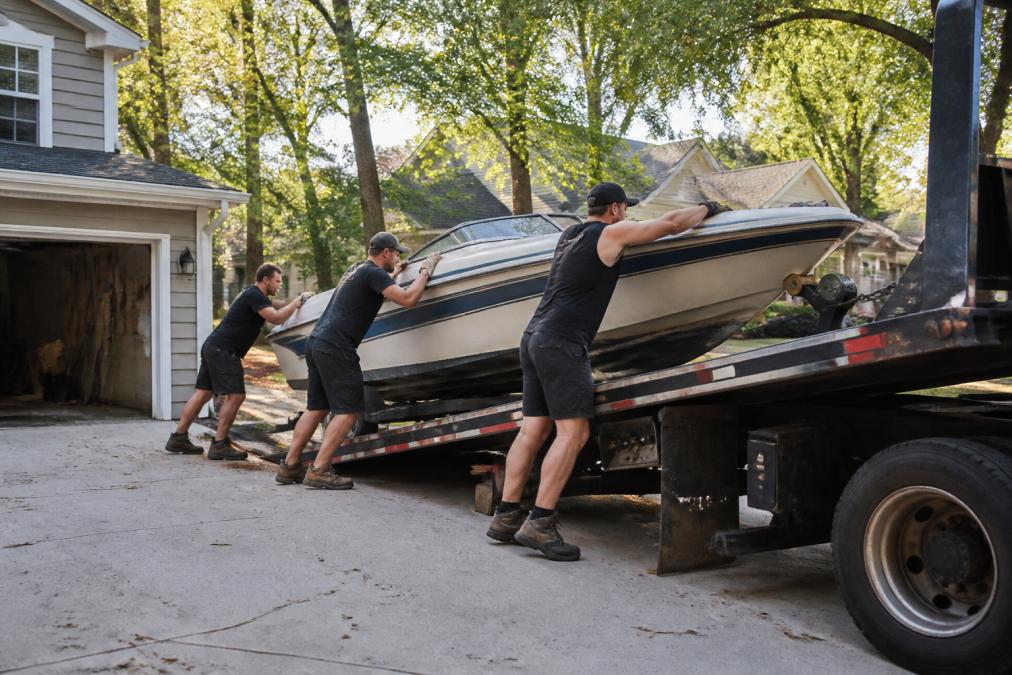
Step 1: Schedule and assessment, Describe your boat's size, condition, location, and trailer status to determine equipment and labor needs.
Step 2: On-site evaluation, The crew assesses accessibility, hazardous materials, and structural condition.
Step 3: Preparation, Fuel is drained, batteries disconnected, and loose items secured.
Step 4: Loading and transport, The boat is loaded and secured using appropriate equipment.
Step 5: Disposal or recycling, The boat goes to a certified facility for deconstruction or proper disposal.
Step 6: Documentation, You receive removal confirmation and documentation for insurance or tax purposes.
The process typically takes one to two weeks from contact to removal, depending on scheduling.
Environmental Regulations and Legal Requirements
Federal and state laws govern boat disposal, especially hazardous materials and ownership transfer.
Environmental Compliance
- EPA hazardous waste guidelines: Fuel, oil, batteries, and paint must be removed and disposed separately. Fuel tanks must be completely drained; batteries require certified recycling.
- State marine debris regulations: Many states prohibit fiberglass boats in standard landfills and require specialized marine recycling facilities.
- PCB and antifouling paint: Older boats may contain PCBs in electrical equipment or hull paint, requiring certified hazardous waste disposal.
Confirm the service understands regulations and works with certified facilities to ensure compliance.
Legal Documentation: Title Transfer and Registration Cancellation
Legal ownership must be formally transferred or registration canceled.
- Locate title and registration, Request duplicates from your state's boating authority if needed ($15-$50, 1-2 weeks).
- Determine donation or scrapping, Charities guide title transfer; removal services require registration cancellation.
- Complete title release form, Your state's boating agency provides the form; some require notarization.
- Submit to state agency, Mail or submit online the signed form, title, and registration with a cover letter.
- Obtain cancellation receipt, Your state issues proof of cancellation (2-4 weeks).
- Inform insurance company, Provide the cancellation receipt and request written policy termination.
Why This Matters
If you don't cancel the registration and release the title, you remain the legal owner on record. Some states impose annual registration fees even on non-operational boats.
Timeline and Costs
The legal documentation process typically takes 4-6 weeks total:
- Obtaining duplicate title/registration (if needed): 1-2 weeks, $15-$50
- Completing and submitting cancellation forms: 1 week
- State processing: 2-4 weeks
- Insurance confirmation: 1 week
There are no filing fees in most states for title release or registration cancellation, though some may charge fees. The main cost is your time and any fees for duplicate documents.
Coordination with Removal Services
When you hire a junk removal service, inform them that you're handling the legal documentation. Most professional services expect this and can provide a removal confirmation letter for your state agency if needed. Do not let the removal service take the boat until you've submitted the cancellation paperwork.
Preparing Your Boat for Pickup
Getting your boat ready for removal makes the process faster and safer for everyone involved.
Before the crew arrives, take these steps:
- Drain fuel, Remove all gasoline and diesel fuel from the tank. Store fuel properly in approved containers.
- Disconnect the battery, Remove the battery and store it safely away from the boat.
- Remove personal items, Clear out any belongings, fishing gear, or equipment you want to keep.
- Document the condition, Take photos for insurance or tax purposes if needed.
- Clear the area, Make sure the boat is accessible. Remove obstacles like cars, debris, or low-hanging branches that could interfere with equipment.
- Locate the title, Have your boat's title and registration ready for the crew.
- Note hazardous materials, Tell the crew about any paint, solvents, or other hazardous items stored on or near the boat.
A clear, accessible boat means faster removal and lower labor costs.
| Preparation Task | Why It Matters | Timeline |
|---|---|---|
| Drain fuel | Prevents spills and environmental contamination | 1-2 days before pickup |
| Disconnect battery | Eliminates electrical hazards during transport | 1 day before pickup |
| Remove personal items | Protects your belongings from being hauled away | 1-2 days before pickup |
| Clear the area | Allows equipment access and faster removal | Day of pickup |
| Gather documentation | Confirms legal ownership | Before scheduling pickup |
Frequently Asked Questions
What's the best way to get rid of a boat?
The best approach depends on your boat's condition and your goals. If the boat still has value, donation to a qualified charity or sale may be ideal. For non-running vessels or those in poor condition, professional junk removal services can handle the process, including proper disposal. Scrap yards also accept aluminum and fiberglass boats, though you'll need to arrange transportation. Rubbish Outlaw can evaluate your boat.
How much does it cost to remove a boat?
Boat removal costs vary based on the boat's size, condition, location, and whether a trailer is included. Pricing depends on quantity, accessibility, and disposal method chosen. Contact Rubbish Outlaw for a free estimate tailored to your boat's specific details.
Will junk removal companies accept fiberglass boats?
Many junk removal services do accept fiberglass boats, but not all. Fiberglass requires proper handling due to its hazardous material components and disposal regulations. Rubbish Outlaw specializes in boat removal and handles fiberglass vessels responsibly. Always confirm that your chosen service handles fiberglass before scheduling.
Do junk removal services handle boat trailers?
Yes, most professional junk removal services remove boats with or without trailers. If your boat has a title and registration, those documents may need to be transferred or cancelled. Rubbish Outlaw handles complete boat and trailer removal.