 how-to
Best Ways to Clear a Basement: 2026 How-To Guide
Table of Contents
- Assess the Basement Before You Clear Anything
- DIY Basement Cleanout Checklist: Step-by-Step
- Dehumidification, Ventilation, and Musty Odor Control
- Junk Removal vs. Dumpster Rental: Which Clears a Basement Faster?
- What Drives the Cost of a Whole House Cleanout?
- Hazardous Waste, Sanitization, and Long-Term Maintenance
- Conclusion: Match the Method to the Mess
- Frequently Asked Questions
Last Updated: October 4, 2026
Assess the Basement Before You Clear Anything
Water, power, and air quality decide whether a basement is safe to enter, the first rule of the best ways to clear basement spaces, and skipping it causes the most injuries.
Look before you step. Standing water can hide live outlets and sharp debris.
- Water: Is the floor wet? Find the source before you start.
- Power: Shut off breakers to any flooded area.
- Air: A musty smell means mold spores are already airborne.
A basement cleanout removes water, damaged materials, and unwanted items from a below-grade space so it can be dried, sanitized, and used again.
Safety Checks: Water, Power, and Air Quality
Never enter standing water near electrical panels. Call a licensed electrician if outlets are submerged.
Wear rubber boots, gloves, and an N95 mask. Open windows and run fans for at least 30 minutes before you work.
If the space has been closed for months, stand at the door for a minute, dizziness or a strong musty smell means ventilate first.
DIY Basement Cleanout Checklist: Step-by-Step
Work top to bottom, dry to wet. This order keeps you safe and stops you from re-soaking a dry floor. The American Red Cross flood cleanup guidance recommends removing water and wet materials before anything else.
- Shut off power to the basement.
- Photograph everything for insurance.
- Pump or wet-vac standing water.
- Pull soaked carpet, cardboard, and drywall.
- Bag trash and set it aside for hauling.
- Run a dehumidifier for 24 to 48 hours.
- Sanitize floors, walls, and shelves.
- Move salvageable items to a dry area.
Removing Standing Water and Wet Materials
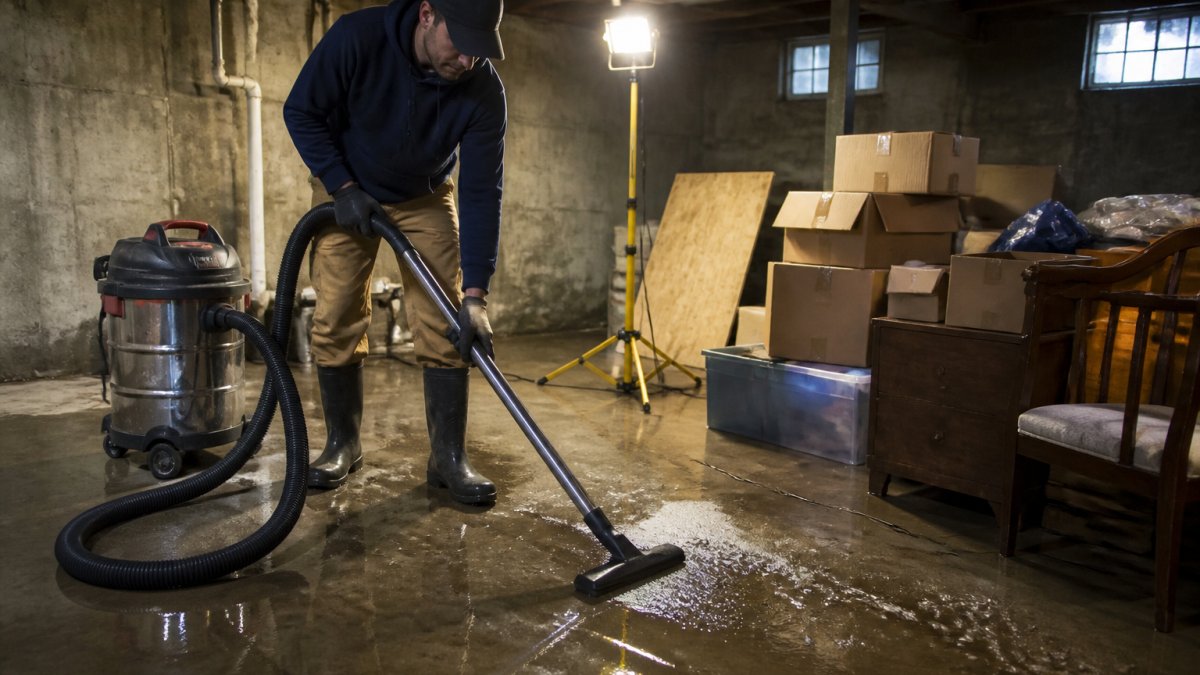
Match the tool to the volume. A wet/dry vacuum handles puddles up to about an inch deep; a submersible utility pump moves roughly 1,000 to 1,500 gallons per hour through a garden hose, enough to clear a shallow flooded floor in a few hours. For anything deeper than a few inches, pump first, then vacuum the residue.
A common mistake is stacking wet boxes on dry concrete, moisture wicks back into the floor and starts mold within a day or two. The CDC treats porous materials wet more than 48 hours as unsalvageable, because mold grows inside before it is visible.
- Cardboard and paper: toss, they cannot be saved.
- Fabric and upholstery: wash within 48 hours or discard.
- Wood furniture: dry in sunlight if solid, discard if particle board.
- Drywall: cut 12 inches above the visible water line, not at it, because wicking travels upward.
- Fiberglass insulation: discard if it was submerged; it holds water and loses R-value.
Snaking, Plunging, and Drain Cleaning
A clogged floor drain causes most repeat floods, so snake the line before assuming it is broken. Order matters: plunge first to break up a soft blockage, then snake what the plunger cannot reach.
Plunging. Use a flange plunger, not a cup plunger, the rubber flange seals a floor drain or toilet outlet where a cup plunger fails.
Snaking. A hand snake (drum auger) works for clogs within about 25 feet.
Chemical cleaners. A drain cleaner like Liquid-Plumr (about $8) dissolves hair and soap scum in a slow drain, but will not fix a collapsed sewer line, root intrusion, or bellied pipe.
Hydro-jetting. A plumber's hydro-jetter uses 3,000 to 4,000 PSI to scour the full pipe diameter, which a snake cannot do.
Dehumidification, Ventilation, and Musty Odor Control
Moisture control is the difference between a clean basement and one that smells musty again in a month. A dehumidifier pulls water from the air, and ventilation moves it out.
Set a dehumidifier to 50% relative humidity and empty the tank daily, or run a hose to a floor drain.
- Run box fans to move air across damp walls.
- Open windows on dry days only.
- Replace cardboard storage with plastic bins.
- Add a HEPA air purifier for musty smell. Alen Air Purifiers start around $299.
Junk Removal vs. Dumpster Rental: Which Clears a Basement Faster?
Junk removal clears a basement faster because the crew does the lifting, loading, and disposal in one visit. A dumpster rental is cheaper per pound, but you supply the labor and timeline.
Here is how the two compare for a typical basement cleanout.
| Factor | Junk Removal | Dumpster Rental |
|---|---|---|
| Who does the labor | Crew loads everything | You load it yourself |
| Typical timeline | Same day | 3-7 days on site |
| Best for | Hoarder and estate cleanouts | Small DIY debris jobs |
| Disposal handled | Yes, by the hauler | You pay landfill fees |
| Heavy items | Included | Often restricted |
For a whole house cleanout, junk removal usually wins on speed. For a small pile of drywall, a dumpster rental costs less.
At Rubbish Outlaw Junk Removal, we handle estate and hoarder cleanouts, demolition, debris removal, and specialized boat removal.
What Drives the Cost of a Whole House Cleanout?
The cost of a whole house cleanout depends on volume, access, and contents. Haulers price by truckload, weight, or flat rate, so ask which model applies before you book.
- Volume: How many truckloads the debris fills.
- Access: Stairs, tight turns, and long carries add labor.
- Material type: Concrete and shingles weigh more than furniture.
- Hazardous items: Paint, batteries, and chemicals cost extra to dispose of.
- Timeline: Same-day or weekend jobs often cost more.
Hazardous Waste, Sanitization, and Long-Term Maintenance
Most basement cleanout guides stop at the dumpster, skipping hazardous waste, sanitization, and maintenance, the three things that decide whether your basement stays clear. Get them right and you avoid a refused load, a mold rebound, and a second flood.
Hazardous Waste: What You Cannot Put in a Dumpster
A debris pile containing paint, batteries, or chemicals can be refused at the landfill, and the hauler can charge a hazardous waste fee or reject the whole load. Sort these out before the truck arrives.
- Latex paint: If it is fully dried (leave the lid off in a ventilated area), most landfills accept it as solid waste. If it is still liquid, it is household hazardous waste.
- Oil-based paint, stains, and solvents: Household hazardous waste. Never pour down a drain or into a storm sewer.
- Batteries: Car batteries, lithium-ion, and rechargeable batteries are all household hazardous waste. Lithium batteries are a fire risk in a truck, tape the terminals.
- Motor oil, antifreeze, and gasoline: Household hazardous waste.
- Pesticides, herbicides, and pool chemicals: Household hazardous waste.
- Asbestos-containing materials: If your home was built before the mid-1980s, pipe insulation, floor tile, and some ceiling materials may contain asbestos. Do not break them up. This is a licensed-abatement job.
- Moldy porous materials: Bag them in heavy-duty plastic before they leave the basement so spores do not spread through the house.
Household hazardous waste goes through municipal collection programs, most counties run periodic drop-off days or a permanent facility. Check your county's solid waste authority for the schedule and accepted items, and never put hazardous waste at the curb.
Post-Cleanup Sanitization and Mold Prevention
Clearing the space is not the same as cleaning it: floodwater and long-standing damp leave bacteria, and mold spores settle on every surface the water touched. Sanitize after the space is dry, not before, disinfectant on a wet wall is diluted and wasted.
For concrete, block, and tile, mix one cup of unscented household bleach per gallon of water. Wear gloves, ventilate, rinse with clean water, and dry fully. Bleach is corrosive to metal and will pit a sump pump housing, so keep it off pumps and electrical components; a quaternary ammonium disinfectant is the standard non-bleach option.
For mold prevention, keep humidity under 60% year-round. Fix leaks within 24 hours. The CDC guidance on mold cleanup after flooding advises discarding porous materials that stay wet more than 48 hours.
Waterproofing Foundation Walls and Preventing Future Floods
Waterproofing foundation walls stops the next flood before it starts. Seal cracks, grade soil away from the house, and keep gutters clean.
Interior sealers. A concrete or silicate-based sealer penetrates the wall and blocks moisture vapor. Silicate sealers react with free lime in concrete to densify the surface, which is why they outperform film-forming paints on damp block.
Exterior waterproofing. The permanent fix for a wall that seeps after every rain: excavate to the footing, apply a membrane, and add drainage, typically $10,000 to $20,000 or more depending on linear footage and access. A major project, not a weekend job.
Interior drainage and sump. For serious seepage where exterior excavation is impractical, an interior perimeter drain (French drain cut into the slab) routes water to a sump pit, where a pump discharges it away from the foundation.
Grading and gutters. The cheapest fix is often the one that works.
- Check the sump pump every spring by pouring a bucket of water into the pit and confirming it kicks on and shuts off.
- Clear the floor drain twice a year.
- Reapply sealer every 5 to 7 years.
- Inspect foundation walls after heavy rain.
- Test the battery backup on the sump pump annually.
Conclusion: Match the Method to the Mess
Every basement is different, and the right method depends on what you face: a few wet boxes need a shop vac and a fan, while a hoarder house, flooded floor, or full estate needs a crew.
That is where Rubbish Outlaw Junk Removal comes in. We handle estate and hoarder cleanouts, demolition, debris removal, and specialized boat removal for homes and businesses in Akron and Canton, Ohio. We haul everything and leave the space ready to use.
Get started with Rubbish Outlaw Junk Removal and reclaim your basement with a free estimate.
Frequently Asked Questions
What is the best way to clear a basement full of water?
Start by cutting power to the basement at the breaker panel and confirming it is safe to enter. Use a submersible sump pump or wet/dry vacuum to remove standing water, working from the deepest point toward the floor drain. Move wet materials, boxes, and ruined furniture out immediately, because mold can begin growing within 24 to 48 hours. Run a dehumidifier and fans to dry the space, then sanitize surfaces. If the water came from a sewer backup, treat everything as contaminated and wear protective gear.
How much does it cost to have a basement cleaned out?
The cost of a whole house cleanout depends on volume, debris type, access, and whether hazardous materials are involved. Small loads of ordinary junk sit at the low end, while full basements packed with furniture, appliances, or construction debris sit much higher. Hazardous items like paint cans or batteries usually require separate disposal and add to the total. For an accurate number, request a free estimate from a junk removal company that can see the space in person or via photos.
How do I dispose of hazardous waste found in a basement?
Old paint cans, batteries, motor oil, pesticides, and fluorescent bulbs cannot go in regular trash. In most areas, these items are handled through household hazardous waste collection events or designated drop-off facilities run by the county or city. Check your local solid waste authority for scheduled drop-off days. If you hire a junk removal service, confirm in advance whether it accepts hazardous materials, since many haulers will not touch them. Keep hazardous items separate from general debris.
How long can water sit in a basement before it causes damage?
Water starts damaging a basement immediately. Drywall, carpet, and wood begin absorbing moisture within hours, and mold can appear within 24 to 48 hours in warm, humid conditions. Structural elements like floor joists and foundation walls weaken over days of saturation. Standing water also raises humidity throughout the house and can compromise air quality. Pump out water and start drying within the first 24 hours to limit damage and avoid costly repairs.