 how-to
7 Steps to Clear Estate Property Efficiently
Last Updated: October 24, 2026
Quick Summary
To clear estate property efficiently, you need legal permission first, the executor or administrator named in court documents has authority to remove belongings, but that authority has legal boundaries. Start by obtaining Letters Testamentary, Letters of Administration, or a small estate affidavit from your county court, then document everything you remove with photos, dates, and itemized lists.
- Obtain court-issued appointment documents like Letters Testamentary or Letters of Administration before removing any items from the property.
- Most estate cleanouts take 2 to 8 weeks depending on house size, with professional help reducing timelines to 1-2 weeks.
- Remove perishables, hazardous materials, and medications immediately; valuable items should be held until probate determines who inherits them.
- Create four sorting categories for belongings: keep, sell, donate, or discard, and document valuable items with photos before selling.
- Professional junk removal costs $150-$600 for a single load or $1,000-$4,000 for a full house, while estate sales charge 25-40% commission on gross sales.
Table of Contents
- Understand Your Legal Authority Before You Clear Estate Property
- Can You Empty a House Before Probate Is Complete?
- Create Your Estate Cleanout Checklist and Timeline
- Sort and Decide: What to Do With Belongings After a Death
- How Long to Clean Out a House: Realistic Timelines
- Handle Time-Sensitive Items and Hazardous Materials
- Schedule Your Professional Estate Cleanout
- Frequently Asked Questions
Understand Your Legal Authority Before You Clear Estate Property
To clear estate property effectively, you need legal permission first, it is more than a physical task. The executor or administrator can remove belongings, but that authority has legal boundaries.
Before touching anything, verify who has the legal right to decide. With a will, the named executor has authority; without one, the probate court appoints an administrator. Removing items without this standing can create serious problems with beneficiaries or heirs.
The documents that actually prove your authority
Courts and title companies do not accept a copy of the will alone. The paper that matters is the court-issued appointment:
- Letters Testamentary, issued when there is a will and the named executor is confirmed.
- Letters of Administration, issued when there is no will, or the named executor cannot serve, and the court appoints an administrator.
- Small estate affidavit, available in many states when the estate falls below a statutory threshold (commonly $50,000-$184,500 depending on the state). This can let you act without full probate, but the threshold and permitted actions vary widely.
Get certified copies from the clerk of the court, you'll need several originals for banks, brokerages, and the DMV. Keep a scanned set in the cloud and a physical set with the estate file.
What the executor can and cannot do without court approval
The executor has broad authority over routine property management but needs court or beneficiary sign-off for anything that changes the estate's value or favors one heir over another.
| Action | Typical authority |
|---|---|
| Remove perishables, trash, and hazardous items | Generally allowed immediately |
| Inventory and photograph belongings | Allowed; in fact required in most states |
| Change locks and secure the property | Allowed as a fiduciary duty |
| Sell personal property | Often allowed for low-value items; higher-value items may need court approval or a formal appraisal |
| Sell real estate | Usually requires court approval or a power in the will |
| Distribute items to beneficiaries | Only after debts, taxes, and expenses are accounted for |
| Give a keepsake to one heir early | Risky without written consent from all heirs or court approval |
State-level variation you cannot ignore
Probate is state law, and the differences are not cosmetic:
- Small estate thresholds range from roughly $20,000 in some states to over $184,000 in others. Below the threshold, an affidavit may replace full probate.
- Community property states (Arizona, California, Idaho, Louisiana, Nevada, New Mexico, Texas, Washington, Wisconsin) treat marital property differently, which affects who can authorize removal of a surviving spouse's share.
- Ancillary probate is required when the deceased owned real estate in another state; the home-state appointment does not automatically cover out-of-state property.
What the executor should document
The executor's records are the estate's defense. Before the first box leaves the house, start a log capturing:
- Date, time, and who was present for each removal session
- Photos of every room before and after clearing
- An itemized list of high-value items with photos and condition notes
This log supports the estate accounting the court requires and protects against claims that an item was sold too cheaply or given to the wrong heir.
The American Bar Association's guide to executor duties explains the fiduciary responsibilities that come with managing an estate. Your probate attorney can confirm which documents your county requires before removal begins.
Can You Empty a House Before Probate Is Complete?
It depends on your circumstances and local laws. Probate can take months or years, and waiting until it's finished isn't always practical.
In many cases you can begin clearing a house while probate is pending, especially perishables and deteriorating items.
The key is understanding what you can and cannot do:
- Remove perishables immediately. Food in the refrigerator and pantry must go right away to prevent waste and odors.
- Clear hazardous materials. Old paint, chemicals, and batteries should be disposed of safely as soon as possible.
- Organize and inventory items. You can sort belongings and document what exists without court approval.
The National Association of Estate Planners & Councils resources on probate timelines provides guidance on what happens during probate and when you can act.
Create Your Estate Cleanout Checklist and Timeline
Create an estate cleanout checklist covering every room and task, and break the project into phases. Include:
- All rooms in the house (bedroom, kitchen, bathroom, garage, basement, attic)
- Outdoor areas (shed, yard, deck)
- Large items (furniture, appliances, vehicles)
Set a realistic timeline: most estate cleanouts take 2 to 8 weeks. A small apartment might take 2 weeks; a full house with decades of accumulation could take 2 months or more.
Break your timeline into phases:
Phase 1: Planning and Documentation (1 week)
- Gather legal documents and understand your authority
- Take photos of the property for insurance and records
- Create your detailed checklist
Phase 2: Sorting and Decision-Making (2-4 weeks)
- Go through each room systematically
- Identify items to keep, sell, donate, or discard
- Secure valuable and sentimental items
Phase 3: Removal and Disposal (1-3 weeks)
- Arrange pickup for donated items
- Schedule professional junk removal if needed
- Dispose of hazardous materials properly
Phase 4: Final Cleaning (3-5 days)
- Deep clean the empty property
- Handle any remaining items
- Prepare the house for sale or transfer
Sort and Decide: What to Do With Belongings After a Death
This is the hardest part emotionally. Take your time and involve family members when appropriate.
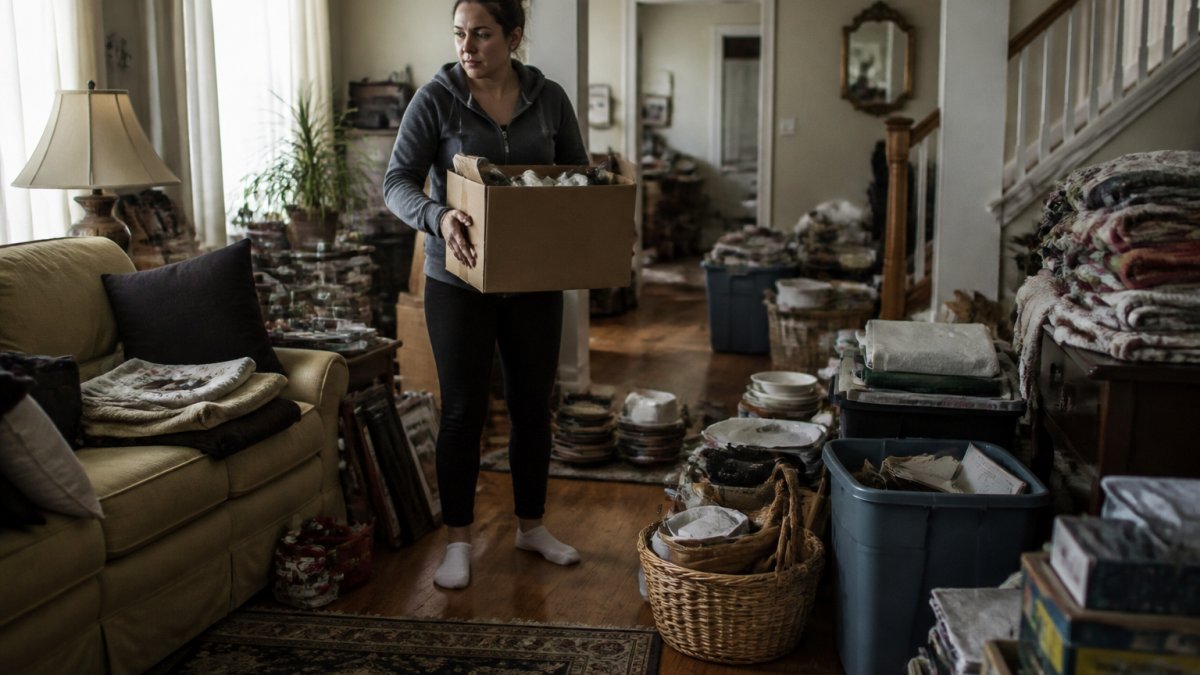
Create four sorting categories for everything:
Keep: Items with genuine sentimental value or that beneficiaries want. Store these safely until distributed.
Sell: Furniture, electronics, jewelry, and collectibles with resale value.
Donate: Clothing, books, kitchenware, and household goods in good condition.
Discard: Broken, worn-out, and unusable items. These go to the landfill or recycling center.
The Salvation Army's donation guidelines explain what items they accept and how the donation process works.
For sentimental items, consider digitizing photos and documents. You can also learn how to handle the emotional stress that comes with sorting a deceased person's belongings.
Document valuable items before selling. Take photos and note condition.
How Long to Clean Out a House: Realistic Timelines
A small apartment with minimal items might take 1-2 weeks; a large house with 40+ years of accumulation could take 8-12 weeks or longer. Key factors:
- House size and amount of stuff. More rooms and possessions mean more sorting and removal time.
- Condition of items. Deteriorated or damaged items take longer to handle safely.
- Help available. Working alone takes much longer than working with family or professionals.
For a typical 3-bedroom house with moderate contents:
Working alone: 6-10 weeks With 2-3 family members: 3-5 weeks With professional help: 1-2 weeks
Professional junk removal can dramatically speed things up, handling heavy lifting, hauling, and disposal, especially valuable with large furniture, multiple rooms, or time constraints.
Handle Time-Sensitive Items and Hazardous Materials
Medications should never go down the drain or in the trash. The FDA's guidance on safe medication disposal provides locations and proper methods.
Hazardous materials include:
- Paint and paint thinner
- Cleaning chemicals
- Pesticides
Contact your local waste management facility for hazardous waste collection days. Many communities offer free disposal for these items on specific dates.
Personal documents and financial records need secure handling. Look for:
- Bank statements and account information
- Insurance policies
- Tax returns
Keep these secure until you've settled the estate. Shred sensitive documents you don't need to keep.
Schedule Your Professional Estate Cleanout
When the job feels overwhelming, professional help makes sense, but "professional help" is several different services with very different costs, timelines, and scope.
The four service models, compared
| Option | Typical cost | What it covers | Best for |
|---|---|---|---|
| DIY with rented dumpster | $300-$700 for a 15-20 yard dumpster, plus disposal fees by weight | You load; the hauler drops and picks up | Smaller homes, families with time and labor |
| Junk removal company | $150-$600 for a single load; $1,000-$4,000+ for a full house | Labor, hauling, disposal, some donation drop-off | Heavy furniture, tight timelines, out-of-state executors |
| Estate sale company | 25%-40% commission on gross sales, sometimes plus a setup fee | Sorting, pricing, staging, running the sale, post-sale cleanout | Homes with substantial sellable contents |
| Donation pickup | Free for accepted items | Pickup of furniture, clothing, housewares in good condition | Homes where most contents are usable |
Prices vary by market, volume, and access, stairs, elevators, and distance from the truck all raise the quote. Get at least two written estimates and confirm whether disposal fees, often billed separately by weight, are included.
What each option will not do
This is where families get surprised:
- Junk removal will haul almost anything but will not sort keepsakes, appraise valuables, or handle legal distribution. You must pull heirlooms and documents before the crew arrives.
- Estate sale companies generally want a minimum volume of sellable merchandise to make the commission worthwhile; they may decline a home that is mostly worn furniture and paper.
- Donation pickups reject stained furniture, mattresses in many markets, and anything that is not in resalable condition. Schedule early, pickup windows can run one to three weeks.
A realistic budget for a 3-bedroom house
For a typical 3-bedroom home with moderate contents, a full professional cleanout can be a significant investment. A DIY approach with a dumpster and family labor often takes three to five weekends. An estate sale can offset costs if contents are sellable, but the commission comes off the top and preparation takes two to four weeks.
How to vet a cleanout company
When choosing a service, look for companies that: You can also find local estate cleanout service providers in your area.
- Handle estate cleanouts specifically and can show a certificate of insurance
- Provide a written, itemized quote rather than a phone estimate
- State in writing where donated items go and whether they provide a donation receipt
Ask what happens to items of unexpected value found during the cleanout. A reputable company will set them aside and notify the executor rather than hauling them away.
Frequently Asked Questions
How long should it take to clean out a house after someone dies?
The timeline depends on the house size, volume of belongings, and complexity of the estate. A small apartment might take a few days; a full house with decades of accumulated items can take weeks. Many families spread the work over several weeks to avoid emotional burnout. Professional estate cleanout services can often complete the job efficiently, depending on the scope. Executor responsibilities and probate timelines may also affect how quickly you can work.
Can you empty a house before probate is complete?
Not without permission. The executor or administrator must have legal authority from the court before removing or distributing any property. Some items, like perishable food or time-sensitive documents, may need immediate attention, but wholesale removal typically requires court approval or a valid will. Check your state's probate rules and consult the court or an estate attorney before clearing the property to avoid legal complications or disputes among beneficiaries.
What should I do with belongings during an estate cleanout?
Sort items into four categories: keep (for beneficiaries or personal use), sell (valuable or useful items), donate (usable goods), and discard (damaged or worthless items). Valuable items may require appraisal for tax or distribution purposes. Important documents, financial records, and sentimental items need careful handling. Hazardous materials like old paint, batteries, and chemicals require proper disposal. Keep detailed records of what was sold, donated, or discarded for estate accounting and tax purposes.
How do I decide what to keep, sell, donate, or discard?
Start by reviewing the will and consulting beneficiaries about sentimental or valuable items. Use online marketplaces or local appraisers to value furniture, jewelry, and collectibles. Donate usable household goods, clothing, and books to charities; many offer free pickup. Discard broken, stained, or obsolete items. Document everything with photos and receipts for estate records. If you're unsure about value, a professional appraiser can help identify items worth selling versus donating.